Echoes of Empire: State Formation and Nation-Building in Contemporary Russia
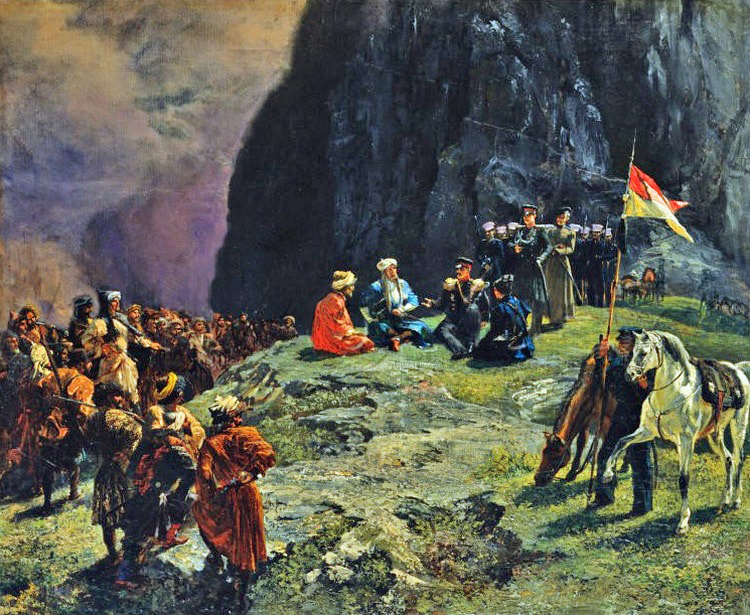
Grigory Gagarin, Meeting of General Klugi von Klugenau with Imam Shamil in 1837 (1849).
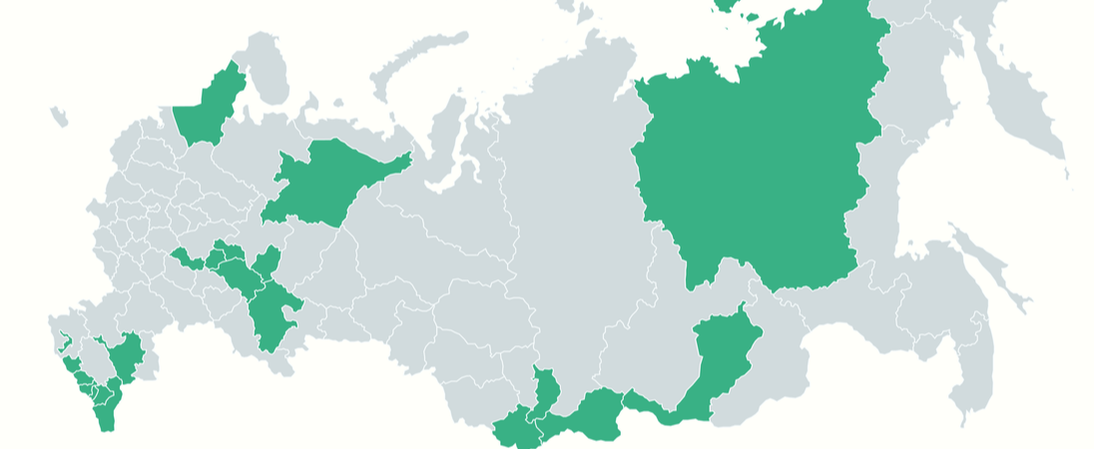
Russia's ethnic republics (shaded in green). Created with mapchart.net
|
My dissertation seeks to explain variation in nationalism across Russia's 21 ethnic republics. Why has nationalism remained strong in some republics, such as Tatarstan, Chechnya, or Tuva, whilst weak or even non-existent in others, such as Mordovia or Udmurtia?
Conventional explanations, such as economic wealth, geographic remoteness, or institutions, fail to account for variation across the entire universe of cases. Instead, I argue that macro-historical factors and elite politics offer a better explanation. I find that historical relations with Russia – notably how non-Russian ethnic groups became part of the Russian state, and ethnic groups’ history of independent statehood – weigh heavily on the degree and strength of contemporary nationalism. In areas that were violently conquered by the Russian state or which had pre-existing statehood, local constitutive stories continue to challenge central narratives by drawing attention to “lost” statehood and sovereignty, as well as the “Otherness” of the Russian state and its core ethnic group. The mechanisms through which the past impacts the present differ. In ethnically mixed regions such as those in the Volga region, nationalizing elites are required to help sustain and foster sub-nationalism, by implementing education and language policies, patronizing the arts, and funding cultural institutions. In ethnically segregated regions, such as republics in Siberia and the Caucasus, pre-modern cultural practices, plus high levels of social and symbolic interaction between co-ethnics, become sustainable and self-reinforcing for preserving such constitutive stories. Drawing upon extensive qualitative and quantitative data, together with controlled case comparisons of several republics using archival documents, local-language scholarship, and content analysis, this dissertation contributes to comparative historical scholarship that traces contemporary outcomes to deeper processes of state formation and imperial expansion. It also provides original contributions to research on multinational states and political integration by theorizing the conditions under which top-down nation-building efforts by national-level elites may clash with sub-national identities. My research also casts a new light on Russian political development under Putin. By taking seriously the macro-historical and elite drivers of nationalism in Russia's republics, post-1999 centralization under Putin appears less secure than is often assumed. This project has been supported by the Harriman Institute of Columbia University and funded by the Carnegie Corporation of New York. |